


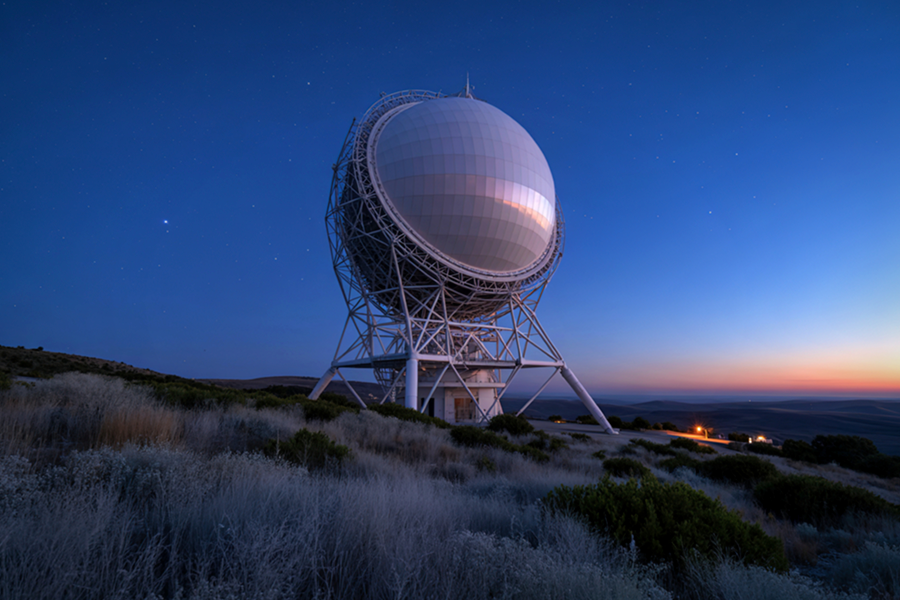
The construction of the world's largest radio telescope began several years ago as part of the Square Kilometre Array Observatory (SKAO).
It will operate in South Africa and Australia to study the evolution of the universe from its earliest stages after the Big Bang, understand how galaxies form and evolve, characterize cosmic magnetic fields, explore intergalactic space, observe black holes and extreme environments in great detail, using pulsars to detect low-frequency gravitational waves. In addition, the SKAO will contribute to the search for conditions conducive to life in other planetary systems.
The first antenna of the SKA-Low radio interferometer was installed in March 2024. In August, antennas were built at four of the telescope's 512 stations, implying that more than 1,000 of its two-meter-high antennas were assembled and installed by field technicians.
Several Chilean researchers are working on this telescope. One of them is Miguel Cárcamo, an academic from the Department of Computer Engineering at the University of Santiago. "The SKA is a radio interferometer that, once operational, will be the largest in the world. It will have a very wide sensitivity and frequency range, especially at low frequencies, which will allow us to study huge structures in the universe, both inside and outside our galaxy. This includes diffuse gas, supernova remnants, distant galaxies with extended emission, and even very faint signals from the intergalactic medium, " said the doctor in Astronomy and Astrophysics at the University of Manchester.
It was in the British city where he connected with researchers working on the observatory and magnetic fields, leading him to join the team. “The SKAO will allow us to explore a huge part of the universe with unprecedented precision. Its capacity will enable us to study the formation and evolution of galaxies, understand the early universe, investigate the role of magnetic fields, and observe extreme phenomena such as black holes and pulsars, as well as contribute to the search for conditions that favor life in other planetary systems,” said Cárcamo.
Despite various delays, worldwide conferences are taking place to showcase the SKA’s progress.
"Although the SKAO is still under construction, research can proceed today thanks to advanced simulations and complementary radio interferometers that function as precursors or pathfinders. Precursors are facilities closely linked to SKAO and directly contributing to its development. Pathfinders, on the other hand, are independent observatories with similar technologies or capabilities that allow us to test algorithms and prepare the science we will do with SKAO," explained the academic.
In Chile, in addition to Miguel Cárcamo, the team of researchers includes astronomer and professor in the Usach Physics Department Sebastián Pérez, as well as specialists from other universities. Together, they attended a conference in Görlitz, Germany, where all the astronomers who are working on writing the scientific cases to be used at the observatory were present.
“It will begin to make its first observations, its first light, in a couple of years. By then, we will already be using the telescope on a more regular basis,” said Pérez.
Regarding the conference, he said, “I gave two presentations, one of which was a plenary session. And it will be very important to complement what we have done here in Chile with ALMA. It is a telescope that operates at a wavelength, that is, it observes light, it observes electromagnetic radiation in colors that ALMA does not see.”
For Sebastián Pérez, this radio telescope “will open a window of observation onto the places where planets are forming and the solid material that is coming together to form planets right now.”
More details about the SKA project, the conferences, and the progress can be found at https://www.skao.int/en.