


As 5G networks expand and the number of connected IoT devices surges, the telecommunications industry faces unprecedented challenges in keeping up with rapid market demands.
Traditional fixed telecommunications infrastructure—like antennas and base stations—struggles to keep up with shifting connectivity demands. In high-density urban areas and major events, heavy network traffic often leads to network congestion and poor service quality. Meanwhile, in rural and remote locations, the high cost of installing physical equipment leaves communities with limited or unstable broadband access.
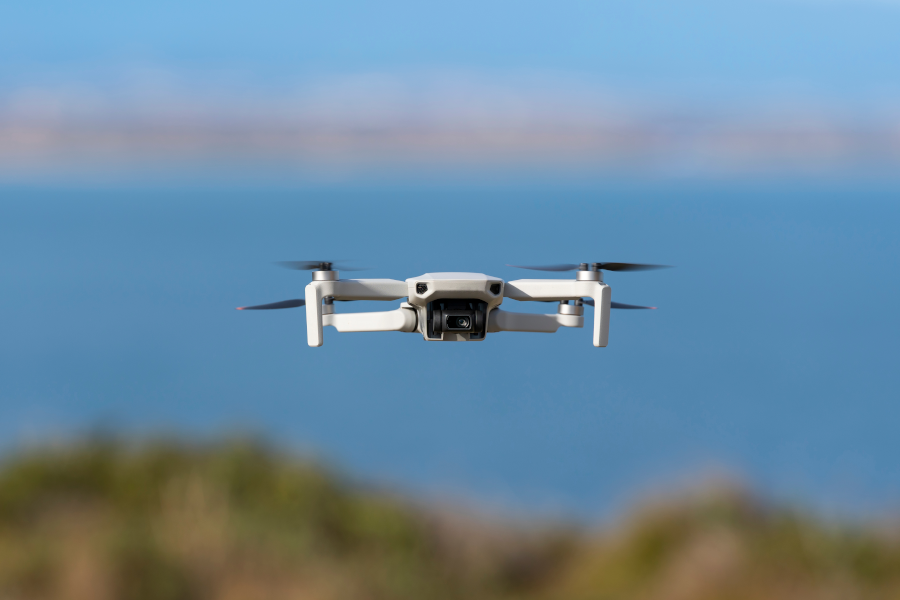
To solve these coverage gaps, Dr. Karel Toledo is leading a Fondecyt Initiation Project designed to build flexible, real-time adaptive wireless networks using autonomous drones. By integrating drones as mobile base stations, the project uses advanced mathematical modeling to boost network performance exactly where demand peaks."Drones can function as mobile base stations that move dynamically according to user demand," explains Dr. Toledo.
Unlike traditional, fixed cell towers, unmanned aerial vehicles (UAVs) can be strategically deployed to provide targeted temporary network coverage. By operating as mobile aerial base stations, these drones dynamically distribute signal load and boost cellular network performance exactly when and where traffic surges.
To enable these drones to adapt to different scenarios and respond efficiently to changes in the network, the project aims to address one of the main challenges of this type of system: uncertainty. In this context, uncertainty relates to unpredictable user movement, signal blockages, and changing bandwidth demand to maintain peak cellular performance.
“To address these scenarios, the project will use simulation models and machine learning algorithms that allow the system to anticipate changes and adapt the drones’ movement in real time, which could lead to a better connectivity experience for people by improving network access and service quality,” explained Dr. Toledo.
Over its three-year timeline, the initiative moves from theoretical design to practical deployment. After establishing a comprehensive conceptual network model, the research team will execute advanced cellular network simulations. The final phase transitions the machine learning algorithms onto physical UAV hardware to validate real-world network performance and evaluate their potential application in future mobile networks.
“We want to move toward more realistic solutions, where these systems can operate on actual hardware and not just in simulations,” explained the researcher.
Furthermore, the work is geared toward the development of new generations of mobile technology; although it is framed within the context of 5G, it also considers applications in more advanced systems. “We have to think about what lies ahead, such as 6G and non-terrestrial networks. In that context, the use of drones as part of the infrastructure will expand connectivity possibilities in environments we can’t even imagine today,” commented Dr. Karel.
Looking beyond current infrastructure, the research lays the groundwork for next-generation mobile networks. While designed for 5G optimization, it also considers applications in more advanced systems. “We have to think about what lies ahead, such as 6G and non-terrestrial networks. In that context, the use of drones as part of the infrastructure will expand connectivity possibilities in environments we can’t even imagine today,” commented Dr. Karel.
Grounded in telecommunications and dynamic systems engineering, the project builds on Dr. Toledo’s foundational research in mobile sensor networks and advanced signal processing. "Building on that experience, this research line has evolved toward cellular communications—integrating drones as a flexible solution to modern coverage gaps and laying the groundwork for future smart connectivity systems," concludes Dr. Toledo.