


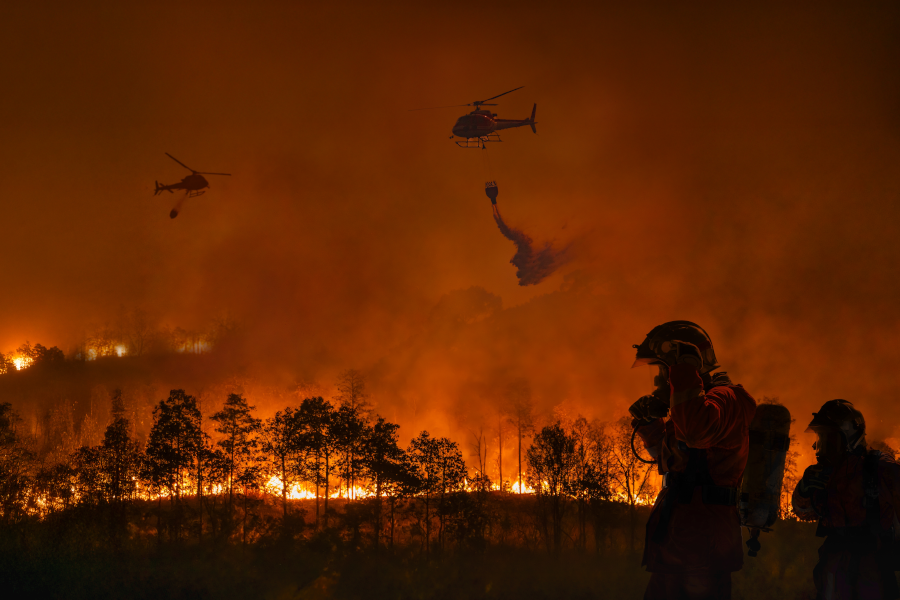
In Chile, wildfires have become one of the country’s main environmental challenges. According to data from the National Forestry Corporation (Conaf), more than 99% of these fires are caused by human activity, whether through negligence or intentionally. Beyond the visible damage to the landscape, the smoke generated by these events contains highly irritating and toxic substances that can spread across vast urban and rural areas.
Due to this ability to disperse, exposure to smoke can affect communities located kilometers away from the fire, including particularly vulnerable groups such as pregnant women and children. This has spurred research aimed at studying the potential consequences of smoke exposure on health, learning, and other aspects of human development.
In response to this issue, Dr. Rubí Arrizaga Zercovich, an academic in the Faculty of Business and Economics, is leading a Fondecyt Initiation project that analyzes the effects of exposure to wildfire smoke on children’s health and academic performance.
The project aims to evaluate how wildfire smoke exposure affects fetal development, child health, and academic performance, tracking how these impacts accumulate over time. To investigate these links, researchers will merge health and educational records with data on wildfire smoke exposure to assess potential impacts on key developmental milestones.
“There are public policies aimed at strengthening child development starting in pregnancy, such as Chile Crece Contigo (ChCC). However, if there is constant exposure to pollution from wildfires, some of those gains could be undermined,” explained the researcher.
Although the project is just getting started, it builds on a line of research the scholar has been developing over the past few years on the effects of wildfires. The Fondecyt grant will allow this work to be expanded to different stages of child development and to incorporate new social and economic dimensions associated with these events.
Addressing a critical aspect of environmental exposure, Dr. Arrizaga explained that “it is often assumed that a fire affects only the place where it occurs, but the smoke plume can travel great distances and reach entire municipalities. The wind carries the smoke to different areas and causes episodes of air pollution that often go unnoticed, even far from the fire.”
To address this issue, the project uses Hysplit, an atmospheric simulation platform (from NOAA) that allows researchers to model the trajectory of smoke plumes and identify which locations were exposed to the particulate matter generated by the fire. This information is then integrated with health, education, and socioeconomic data, which are analyzed using statistical and econometric methods with Python and R software.
To address this challenge, the team uses Hysplit, NOAA's atmospheric platform, to simulate smoke trajectories and track the locations of fire-generated particulate matter. They then combine these environmental exposure maps with health, education, and socioeconomic records, analyzing the combined data using statistical and econometric models in Python and R.
The areas analyzed are primarily concentrated in the Coquimbo and Los Lagos regions, where forest fires have historically been frequent. “The highest concentration of fires occurs in these areas, mainly due to climatic conditions and vegetation characteristics that facilitate the spread of fire,” explained the researcher.
In addition, the research incorporates new lines of analysis—specifically regarding crime and SMEs—expanding the study to other social and economic dimensions associated with wildfires. To explore these lines of inquiry, the project is working with information provided by institutions such as CONAF and entities involved in educational data, as well as through international academic collaborations.
“In North America, studies are showing that wildfires can influence subsequent social and economic dynamics. We want to analyze how those effects might manifest in Chile and what insights can be drawn from the available data,” Arrizaga noted.
Finally, the researcher emphasized that wildfires are not merely temporary emergencies, but phenomena with lasting consequences for the country’s human capital and development. “We hope to provide scientific evidence that will contribute to the design of public policies aimed at prevention, risk management, and the protection of vulnerable communities in the face of the increasing number of wildfires in Chile,” concluded Dr. Rubí Arrizaga Zercovich