


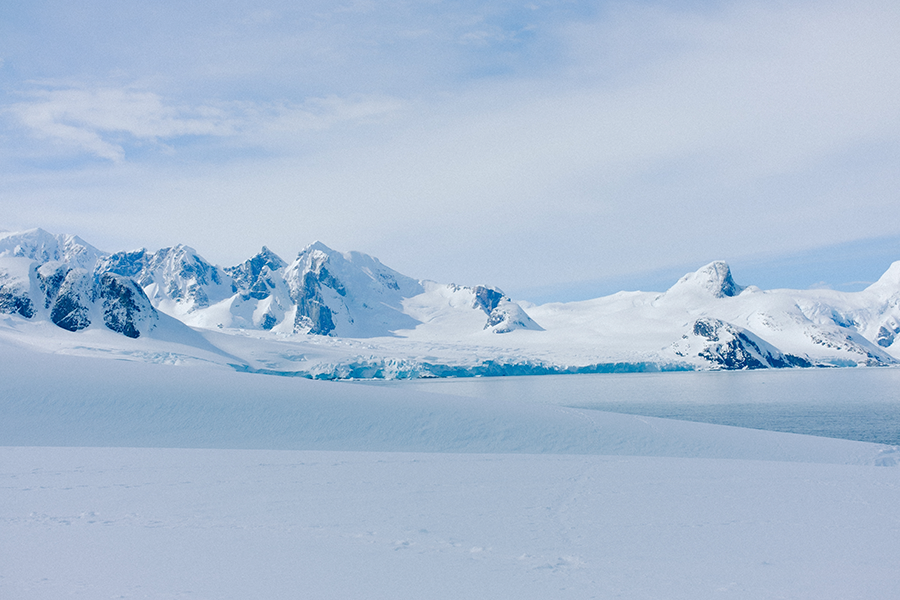
The replacement of the Teniente Luis Carvajal Villarroel Scientific Base on Adelaide Island, Chilean Antarctica, is the central focus of a new thesis project by Javiera Bustamante. A graduate of the University of Santiago (Usach), Bustamante developed the proposal in 2025 as part of the Trama 39 Call for Proposals, under the guidance of professors Jorge Mancilla, Pedro Pablo Cordovez, and Juan Carlos Alarcón.
Responding to a specific need of the Chilean Antarctic Institute (INACH) and the Ministry of Public Works (MOP), the project addresses the urgent need to replace research infrastructure at Carvajal Base. As Chile's southernmost scientific outpost located within the Antarctic Circle, the facility is critical for strengthening national scientific exploration in the polar region.
"During the final thesis workshop, 'Public Wooden Buildings in Extreme Zones'," the supervising professor presented a list of projects being developed by the Ministry of Public Works, including three in Antarctica: two scientific bases and a gym. I chose the Carvajal Base because of the personal challenge involved in designing in an unknown territory, about which little is known beyond its extreme climatic conditions," explains Javiera Bustamante, a graduate of Usach Architecture and the driving force behind the proposal.
The Foundation
The region’s extreme weather conditions—low temperatures, persistent winds, snow accumulation, and logistical constraints—call for precise architectural solutions tailored to this context. In response to these challenges, the project introduces new facilities designed to operate in a highly demanding environment. This comprehensive approach harmonizes structural durability, spatial efficiency, and sustainable energy strategies tailored for the polar context.
Central to the design is comprehensive autonomy, ensuring the complex operates independently across all essential systems. This principle mandates the selection of materials, energy strategies, and spatial configurations. Given the site’s isolation, fire resistance is integrated as a primary safety standard to ensure long-term resilience.
La propuesta proyecta el funcionamiento permanente de la Base Carvajal durante todo el año, ampliando las condiciones de habitabilidad para equipos científicos y técnicos y asegurando la continuidad de la investigación antártica. Desde la arquitectura, el proyecto se formula como una respuesta técnica y territorialmente situada a un encargo real, donde el diseño actúa como soporte operativo para la actividad científica chilena en uno de los entornos más extremos del planeta.
Central to the design is comprehensive autonomy, ensuring the complex operates independently across all essential systems. This principle dictates material selection and spatial configuration, with fire resistance serving as a critical safety standard given the site’s isolation.
The proposal envisions the permanent operation of the Carvajal Base, improving living conditions for scientific and technical teams and ensuring the year-round continuity of Antarctic research. From an architectural perspective, the project is formulated as a technically and territorially situated response to a real commission, in which design acts as operational support for Chilean scientific activity in one of the most extreme environments on Earth.
The Contest
The 39th International Call for Architecture Thesis Projects by Trama Magazine is officially open. Eligible applicants include architects' thesis projects completed from 2022 to 2025. Winning submissions will be published in Trama 192 (print and digital), to be released during the third week of January.