


Artificial Intelligence (AI) systems are revolutionizing industries and companies, making their operations more efficient, effective, and even more sustainable.
These technologies could help optimize the monitoring of industrial fishing vessels to track bycatch, the practice of throwing non-target species caught incidentally back into the ocean.
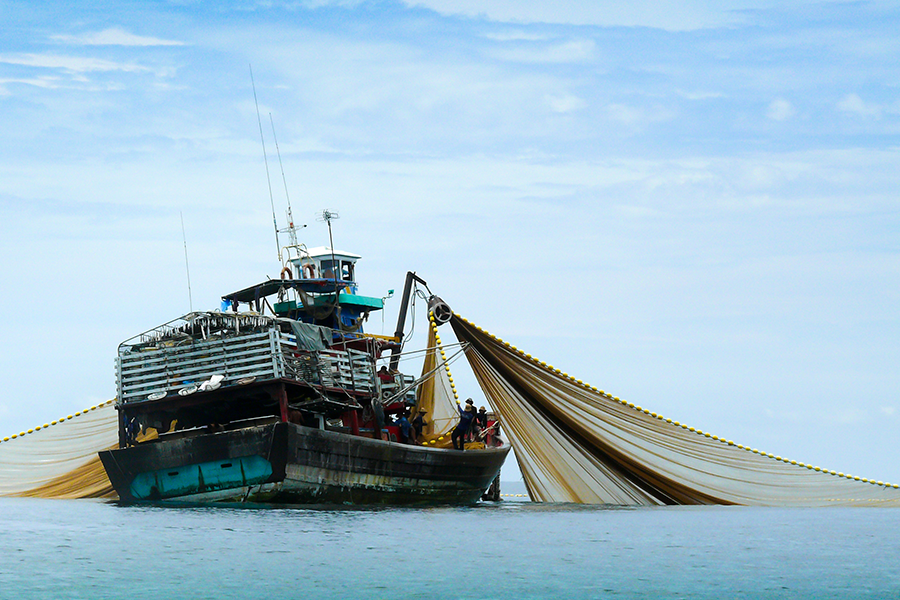
To address the problem of fishing discards, the University of Santiago de Chile (Usach) is proposing a smart solution. The system is designed for industrial vessels between 15 and 18 meters in length, and uses AI and satellite communication to monitor discards in real-time, making oversight more efficient.
Led by Dr. Violeta Chang and funded by ANID, this research is a collaborative effort with two key partners: Sernapesca and the company IO-SAT Chile. Sernapesca will act as the recipient and evaluator of the technology, while IO-SAT Chile will provide expertise in connectivity and satellite monitoring. The project's implementation is supported by the Vice-Rector's Office for Research, Innovation, and Creation (Vriic) via its Technology Management Directorate (DGT).
Innovation with AI models
According to Dr. Chang, the initiative was created to provide a concrete solution to the oversight carried out by Sernapesca. Although boats are required to install cameras on board, the recordings are stored on hard drives that can take up to a year to be reviewed manually, which delays monitoring and limits legal action in the event of violations.
“Discarding is a problem that requires both technical and regulatory solutions to reduce its impact on marine ecosystems and move towards more sustainable fishing,” says the academic.
In this context, she says that “our technological proposal is based on self-supervised, multimodal AI models capable of integrating information such as video, location, and navigation speed to detect anomalies and issue automatic satellite alerts to the competent authorities.”
For her part, Soledad Tapia, national director of Sernapesca, values the collaboration with our University, emphasizing that “it is a big step forward because it will allow us to be much more efficient and effective in monitoring discards, contributing to the sustainability of fishery resources. In this way, we will take much better care of biodiversity and the health of the oceans,” she says.
R&D capabilities
The team led by Dr. Chang has extensive experience in the development of video analysis-based technologies, previously applied in sectors such as mining, health, and the environment. Technical support will also be provided by the company IO-SAT, which will contribute its expertise in satellite communication for complex or difficult-to-access areas.
The research will last two years and is structured in four stages. The first stage involves the creation of a database, with the collection and annotation of videos in conjunction with Sernapesca. In the second stage, “the AI model will be developed that will enable the automated analysis of recordings and the online detection of anomalous behavior through an iterative improvement process,” explains Dr. Chang.
Meanwhile, in the third phase, a physical prototype will be built, integrating all the AI and satellite communication components. With the software and hardware already tested at the laboratory level, the fourth stage will involve the validation of this technology in a real environment, consisting of “the installation and operation of the device on a vessel assigned by Sernapesca,” notes the academic.
This development is expected to advance from a technological maturity level of TRL 2 to TRL 5. “Our goal is to provide a concrete tool that modernizes the inspection process, strengthens the protection of marine biodiversity, and contributes to mitigating the effects of climate change,” concludes Dr. Violeta Chang.