


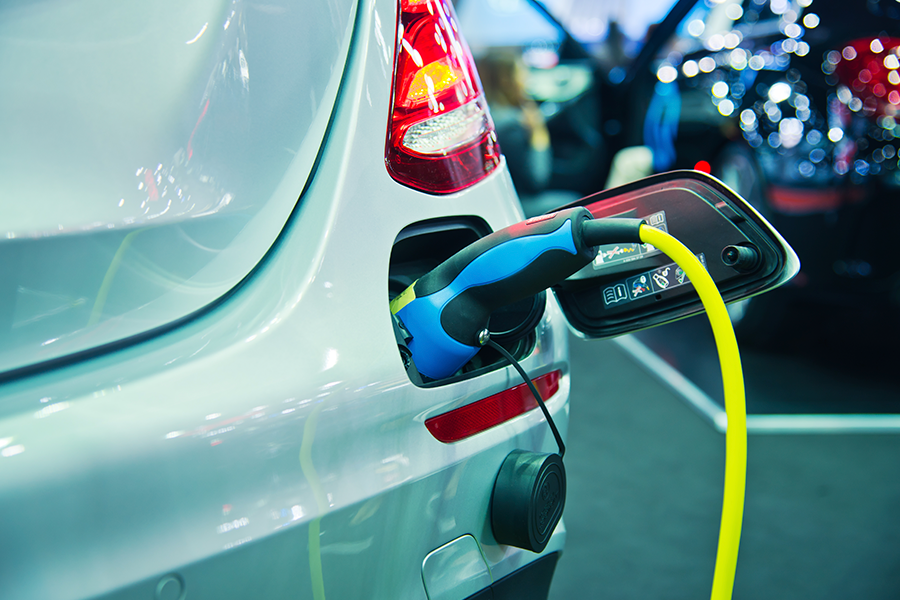
With his project, “Development and Validation of an Ultra-Fast Modular Charger for Electric Vehicles with Simultaneous, Priority, and Vehicle-to-Everything (V2X) Charging Functions,” Dr. Matías Díaz of the Department of Electrical Engineering was one of just 11 researchers nationwide to receive funding from the National Research and Development Agency (ANID) under the R&D Advanced Technologies 2025 call. This highly selective grant focused on critical areas, including fair decarbonization, climate resilience, digital transformation, and diversification of the productive matrix.
This specific call for proposals targets applied research and technological development requiring extensive cycles for validating small-scale prototypes. Dr. Díaz's project, which directly supports fair decarbonization, has been awarded 687 million pesos in funding. The initiative must be executed within 48 months, with the possibility of an exceptional extension of up to 12 additional months.
"This project represents a major new step in E2Tech’s technological maturity. Out of 93 applications, only 11 were awarded, and, to the best of our knowledge, ours is the only one in Chile in the field of electrical engineering. This is the fourth IDEA project I've led, which confirms the success of our working model—taking technologies from the lab to the market—and significantly strengthens the Electrical Engineering Department's capacity for innovation in electromobility and energy."
Ultra-Fast Modular Charger Project
Current DC chargers are often limited by being unidirectional, rigid, and having fixed capacity, which restricts the deployment of widespread fast and multiple charging. This has created a growing demand for advanced solutions that integrate services like Vehicle-to-Everything (V2X) for bidirectional grid interaction. To address this, Dr. Díaz proposed an innovative charger based on the Modular Multilevel Converter Series-Parallel (MMC-SP) topology, enabling fast, ultra-fast, and simultaneous DC charging.
This technology originated in project ID21I10412, awarded under the IDEA R&D 2021 call, which successfully led to a functional prototype validated in the laboratory. This milestone corresponds to Technology Readiness Level 4 (TRL 4) on the TRL scale, which was originally developed by NASA. Ranging from TRL 1 (basic principles observed) to TRL 9 (proven under real operating conditions), TRL 4 specifically indicates experimental validation in a controlled environment.
This recently awarded project represents the continuity and scaling of the MMC-SP, which has already been recognized for its inherent modularity and scalability. The overall objective, according to Dr. Díaz, is to advance the ultra-fast charger from its current state to TRL 7, redesigning it to function not merely as a laboratory prototype but as a market-ready product. This will involve developing hierarchical control algorithms, conducting offline and real-time simulations, and constructing a high-fidelity 100 kW prototype for validation in relevant operational environments. The final charger will ensure energy efficiency, power quality, and flexibility through modular expansion, multiple and priority load management, and Vehicle-to-Everything services.
Research Challenges
The research team behind the Ultra-Fast Modular Charger for Electric Vehicles project is a collaborative effort led by Dr. Matías Díaz and featuring contributions from Dr. Enrique Espina and Dr. Karel Toledo, along with E2Tech researchers Cristóbal Rodríguez and Tomás Ravet. Academics from the University of Chile further strengthen the team, Dr. Roberto Cárdenas and Dr. Constanza Ahumada.
The project faces several key technical challenges, all aimed at advancing the technology to a TRL 7 product:
-Hierarchical Control Algorithms: The development and validation of primary, secondary, and tertiary level algorithms are essential for enabling modularity, scalability, and advanced V2X (Vehicle-to-Everything) services.
- Low-Cost Control Platform: The team is focused on replacing expensive commercial platforms with customized embedded systems designed for cost efficiency and necessary for integrating existing EV charging standards like CCS and CHAdeMO.
-Medium-Frequency Transformers (MFT): Implementation of modular MFTs at each charging point is crucial for providing galvanic isolation and ensuring regulatory compliance.
-Power Scaling: A core objective is the design iteration required to achieve industrial power levels of up to 4.5 MW, while simultaneously guaranteeing high efficiency and robustness.
The successful resolution of these challenges will result in a high-fidelity prototype that is operationally validated at Technology Readiness Level 7 (TRL 7).
Projections
The MMC-SP charger's modular and scalable design makes it highly versatile, allowing for adaptation across various operating conditions—from small residential and commercial installations to high-power industrial applications. The primary beneficiaries will be electric vehicle (EV) users, who stand to gain from significantly reduced charging times, access to flexible infrastructure, and V2X services that optimize energy costs while enhancing the stability of the power grid.
To ensure the long-term success and broad deployment of this technology, the project includes focused strategic planning. Key initiatives being considered involve developing strategies for scaling up to mass production, securing intellectual property protection and commercialization, establishing programs for technical capacity building, and advancing the generation of new scientific and technological knowledge.